


Buying a used appliance in the UAE should feel confident, not risky. Whether you are picking up a washing machine in Dubai, a refrigerator in Sharjah, or an AC unit in Abu Dhabi, the mistake most buyers make is relying on gut feeling instead of a structured evaluation. After years of inspecting, buying, and reselling thousands of used appliances across all seven emirates, I developed a repeatable scoring method that removes guesswork entirely. This is the same appliance buying scorecard my team uses every single day and now you can use it too.
What Is an Appliance Buying Scorecard?
An appliance buying scorecard is a structured evaluation framework that assigns weighted scores to the most critical quality and value factors of any used appliance. Instead of asking “does this look okay?”, you ask ten specific questions, score each one from one to ten, and arrive at a total that tells you whether to buy, negotiate, or walk away. The scorecard works for refrigerators, washing machines, air conditioners, dishwashers, dryers, ovens, water heaters, and any other major household appliance.
The method is not just about conditions. It weighs brand reliability, energy efficiency ratings, remaining lifespan, spare parts availability in the UAE market, and the seller’s transparency — all factors that determine whether a used appliance gives you value or becomes a maintenance problem within six months.
Why UAE Buyers Need a Scoring System
The used appliance market in the UAE moves fast. Listings on platforms like Dubizzle, Facebook Marketplace, and WhatsApp groups disappear within hours, and sellers rarely volunteer negative information. The humid coastal climate in Dubai, Sharjah, Ajman, and Umm Al Quwain accelerates internal corrosion in appliances with poor sealing. Dusty inland conditions in Abu Dhabi, Al Ain, and Ras Al Khaimah clog filters and compressors faster than buyers expect. A washing machine that looks pristine in a Jumeirah apartment may have spent three years next to a window with salt air exposure. None of that is visible without a checklist.
Beyond condition, the UAE’s mix of 220V and 240V electrical infrastructure, hardwater supply in most emirates, and high ambient temperatures during summer months mean that an appliance’s suitability for local conditions matters as much as its general quality. The scorecard accounts for all of this.
The 10-Point Appliance Buying Scorecard
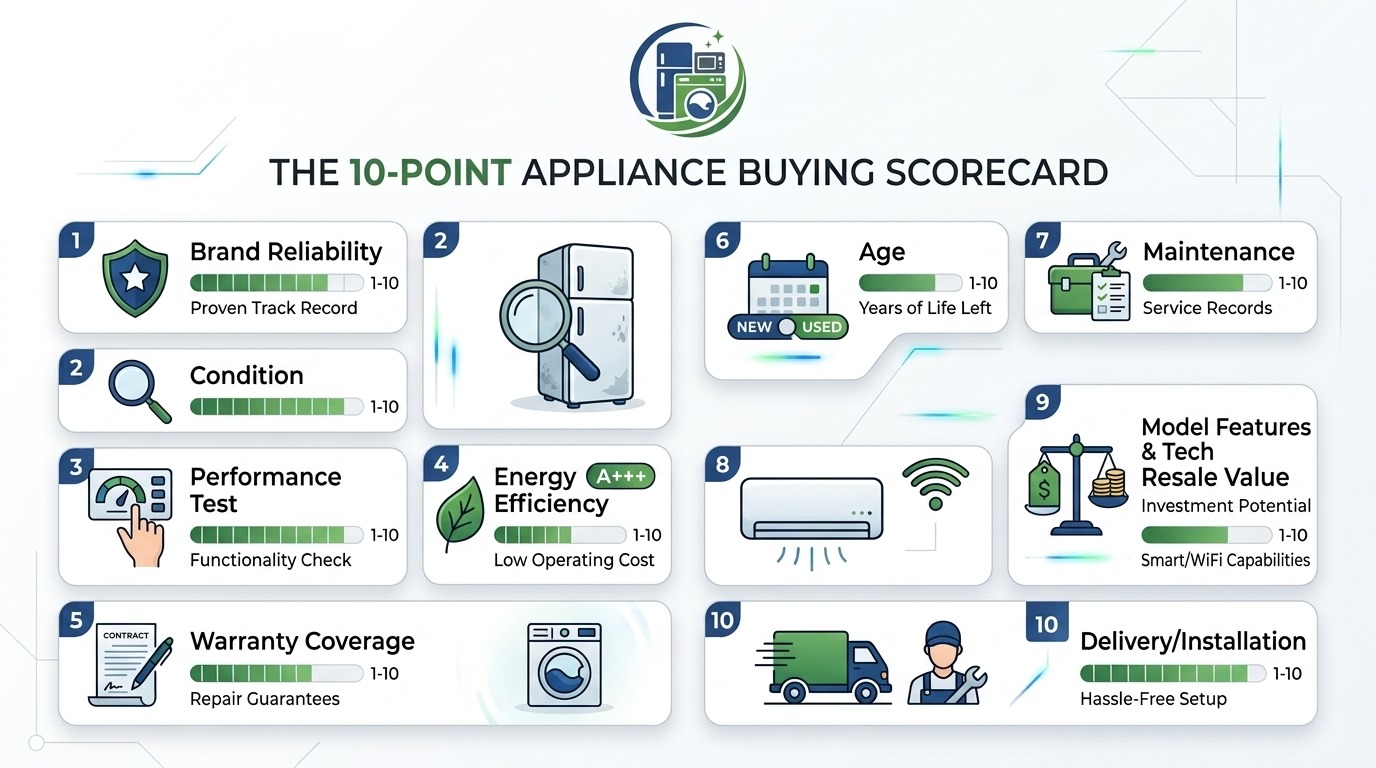
Each category is scored from 1 (poor) to 10 (excellent). A total score of 75 or above out of 100 is a confident buy at the listed price. A score between 55 and 74 is a negotiation zone — the appliance may be worth purchasing at a 20 to 35 percent discount. A score below 55 is typically a pass unless you have a specific repair budget and technical knowledge.
Category 1 — Brand Reliability (Weight: 15%)
Score the brand based on its track record for durability in the UAE market, availability of authorised service centres, and the typical lifespan of its product category. Brands with strong UAE service networks — including LG, Samsung, Bosch, Electrolux, Midea, and Hitachi — score higher because spare parts are accessible and technicians are familiar with their units. Obscure brands with no local service presence score lower regardless of how new the appliance is, because a single fault can make the unit unrepairable in the UAE.
Ask: Does this brand have a service centre within reasonable distance? Are spare parts stocked locally? Has the brand historically exited the UAE market or changed distributors?
Category 2 — Physical Condition (Weight: 20%)
This is the most visible category but not the most important one. Inspect the exterior panels, door seals, handles, hinges, knobs, and control panels. Surface scratches on a refrigerator body are cosmetic and score only minor deductions. Dents near the compressor area, cracked door gaskets on a washing machine, or a warped oven door that does not seal flush are functional problems and score heavily lower.
For this category, always bring a small flashlight. Look behind and underneath the unit for rust stains, leakage marks, or repaired sections. Check the power cable for fraying or replaced connectors, which sometimes indicates past electrical faults.
Category 3 — Functional Performance (Weight: 25%)
This is the highest-weighted category because a used appliance that does not perform its core function has no value. Always test before you buy. For a refrigerator, the compressor should start within two minutes of being plugged in and the internal temperature should begin dropping within five to eight minutes. For a washing machine, run a short cycle and check that the drum rotates without grinding noise, water fills and drains completely, and the spin cycle does not cause the machine to walk or vibrate excessively. For an air conditioner, the compressor should engage quickly, the airflow should be strong and cold within three minutes, and the unit should not make rattling or squealing sounds.
If the seller refuses to allow a functional test, treat this as a red flag that lowers the entire scorecard significantly, regardless of how well the unit scores in other categories.
Category 4 — Age and Remaining Lifespan (Weight: 10%)
Every appliance category has a standard lifespan. Refrigerators typically last 10 to 15 years. Washing machines average 8 to 12 years. Air conditioners run 7 to 10 years with proper maintenance. Dishwashers last 8 to 10 years. A five-year-old refrigerator from a reliable brand still has 60 to 70 percent of its usable life ahead of it and scores well in this category. A nine-year-old unit of the same brand, regardless of condition, is already in its final years and scores lower because you are buying near the end of its reliable service life.
Always ask for the original purchase receipt or warranty card. If the seller cannot provide either, check the manufacture date printed on the serial number sticker, which is almost always located on the back panel or inside the door frame.
Category 5 — Energy Efficiency Rating (Weight: 10%)
In the UAE, DEWA, SEWA, FEWA, and ADDC electricity tariffs make energy consumption a real monthly cost, not just an environmental consideration. An appliance with a poor energy rating — typically two stars or below under the Emirates Authority for Standardization and Metrology (ESMA) scale — will cost you meaningfully more per month compared to a three or five-star equivalent. When evaluating a used appliance, check the energy label on the unit or look up the model number online. A well-maintained five-star refrigerator five years old often has a lower total cost of ownership than a one-star unit that is brand new, because the energy savings compound over months and years.
Category 6 — Maintenance and Service History (Weight: 10%)
A used appliance with documented service history is significantly more trustworthy than one sold with no records. Ask the seller directly: has this unit been serviced, repaired, or had any parts replaced? If yes, ask what was replaced and by whom. Repairs done by authorised service technicians using original parts score positively. Repairs done by informal technicians using non-original parts score lower, but are not automatically disqualifying — context matters. An appliance that has never needed a single repair in eight years is ideal. An appliance that had its compressor replaced two years ago by an LG-authorised technician is still a good buy. An appliance with five informal repairs in three years is a machine with recurring problems.
Category 7 — Spare Parts Availability (Weight: 5%)
This category is particularly relevant in the UAE, where certain appliance models are regional imports and their spare parts are not stocked locally. Before purchasing, search the model number on platforms like Noon, Amazon.ae, or contact a local spare parts supplier in Naif or Satwa (Dubai) or Industrial Area in Sharjah. If key components like the main control board, compressor relay, or door seal are not available in the UAE, a single fault could make the appliance permanently unusable. Appliances with widely available parts score higher.
Category 8 — Seller Transparency (Weight: 5%)
How the seller behaves during your inspection tells you a great deal about the appliance. A seller who answers questions directly, allows a full functional test, discloses known issues, and lets you examine the unit without rushing scores highly on transparency. A seller who rushes the sale, discourages testing, deflects questions about the appliance’s history, or insists on cash only with no receipt scores low. Seller transparency does not guarantee appliance quality, but low transparency is a consistent predictor of undisclosed problems.
Category 9 — Price vs. Market Value (Weight: 5%)
Compare the asking price to the current market rate for the same model in similar condition across UAE platforms. A washing machine listed at 40 percent below market average for its age and brand is either a distress sale or has hidden faults. A unit priced at 10 to 20 percent below market in good condition is the sweet spot. If the seller is asking close to new price for a unit that is several years old, the scorecard helps you quantify exactly why that pricing is unjustified, giving you a factual basis for negotiation.
Category 10 — Warranty or Return Option (Weight: 5%)
Private sellers in the UAE rarely offer any form of guarantee. Dealers and platforms that offer even a 30-day return window or a short warranty on parts score significantly higher in this category because it reduces your post-purchase risk. When buying from Zain Used Appliances Trading, every unit is tested, cleaned, and sold with a defined return policy — something private sellers almost never match. If the seller offers nothing and the appliance has no remaining manufacturer warranty, score this category low and account for it in your final price negotiation.
How to Use the Scorecard: A Practical Example
Imagine you are evaluating a used LG front-load washing machine in Dubai, listed at AED 650, approximately four years old, with no service records.
Brand Reliability: LG has strong UAE service infrastructure — score 8. Physical Condition: Minor scratches, intact door seal, good panel condition — score 7. Functional Performance: Seller allows a test, drum runs smoothly, no unusual noise, drains fully — score 9. Age and Lifespan: Four years old, roughly 6 to 8 years of useful life remaining — score 7. Energy Efficiency: Model carries a 4-star ESMA rating — score 8. Maintenance History: No records available, seller says no repairs — score 5. Spare Parts Availability: LG parts widely available locally — score 8. Seller Transparency: Answered all questions, allowed full test, disclosed minor cosmetic damage — score 8. Price vs. Market Value: Market average for this model and age is AED 700 to 800 — score 8. Warranty or Return: No warranty offered — score 3.
Weighted total: approximately 76 out of 100. This is a confident buy at the listed price, and any negotiation down to AED 550 to 600 makes it an excellent deal.